Miep
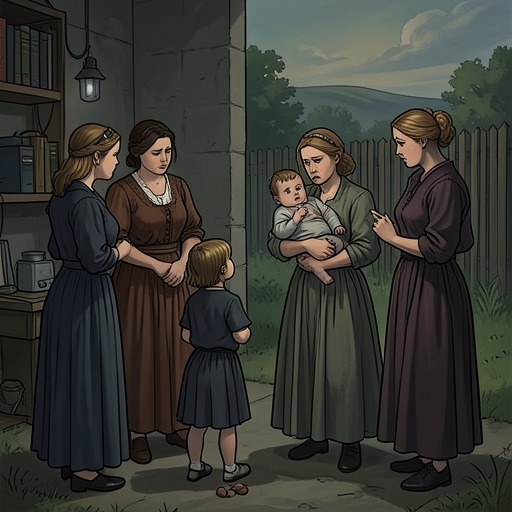
Women TalkingMiep is Salome Friesen’s youngest daughter, a three-year-old whose vulnerability gives the women’s arguments about safety a concrete and intimate focus. After men in Molotschna Colony assaulted her on two or possibly three occasions, she needed antibiotics that Peters had refused to provide. Her mother went twelve miles to another colony to obtain them. Later, when Miep becomes frightened by the women’s raised voices, the meeting pauses around the work of comforting her. She is not a participant in the women’s decisions, but her needs and safety shape what those decisions mean.
Identity and Circumstances
Miep is still very young: she needs help with her medicine and diaper, and her mother carries and comforts her. The circumstances surrounding her care are shaped by the colony’s response to the assaults. Peters denied her medical treatment, concerned that a doctor might gossip about the colony and that public awareness would make the incident appear larger. Salome instead made the long walk to a neighboring colony, where she knew a Mobile Klinic was temporarily stationed for repairs, and obtained antibiotics there.
The treatment is difficult to administer because Miep will not swallow it readily. Salome hides the medicine in Miep’s strained beets. This small domestic detail shows the distance between the seriousness of what has happened and the ordinary, patient labor required to care for a three-year-old afterward. Salome is also expected to bring food to some of the colony’s elders; her daughter’s medication and her assigned service occupy the same day, even as the community’s leaders have failed to secure Miep’s care.
Fear and Comfort in the Hayloft
During a women’s meeting in the hayloft, Miep climbs the ladder and calls for her mother. The women have been yelling, and she is crying and frightened. She asks Salome to change her diaper, shyly, though she is three. Agata explains that Miep had been out of diapers for nearly a year but had recently asked to wear them again. The change is reported without a diagnosis or explanation; its significance lies in the contrast between a newly acquired independence and a return to a form of care she had left behind.
Salome picks Miep up, strokes her hair, whispers to her, and kisses her. Ona puts an arm around Salome’s shoulders while Salome holds her daughter. The scene draws the women’s attention from abstract discussion to a child who has heard their distress and needs reassurance. When Agata suggests singing to Miep, Greta agrees, and the women sing Children of the Heavenly Father. Even the teenagers, Autje and Neitje, visibly distressed by the suggestion, join in. The song makes collective care audible: the women answer the fear that has entered their meeting not with another argument, but with a shared act directed toward Miep.
A Child at the Center of the Women’s Arguments
Miep’s experience is also present when Salome argues that the women must be able to protect their children without depending on the men who have failed them. In a later outburst, Salome insists that she will protect her child from anyone who would harm her. Miep wakes at the raised voice and begins to cry. The meeting’s conflict therefore reaches her even when the women are speaking about faith, forgiveness, and what action they should take. The contrast is stark: the adults debate how to prevent further harm, while Miep responds to the sound and intensity of their disagreement.
The question of which children could accompany the women if they leave extends beyond Miep but grows from the same concern. Salome asks why boys aged thirteen and fourteen would be left under the care of men when younger boys may go with the women, and raises the possibility that they too could be targeted. The argument treats children of different ages as differently exposed, rather than assuming that one plan will protect them all. In this debate, Miep’s case stands at the youngest end of a wider range of children whose safety the women are trying to consider.
Narrative and Thematic Significance
Miep’s presence clarifies what the women’s competing positions put at stake. Agata argues that staying could draw the community into further violence and compromise its commitment to pacifism; she later maintains that leaving is a way to protect themselves and their children while remaining faithful to love and forgiveness. The women’s decision is therefore not simply a choice between action and inaction. It asks what their religious commitments require when children have already been left without adequate protection. Miep’s need for medicine and comfort makes that question immediate without making her responsible for answering it.
Her appearances are brief, but they connect private care to the larger meeting. A hidden dose in strained beets, a request to return to diapers, a frightened child in her mother’s arms, and a song offered by the women each show care taking a different form. The available scenes do not establish Miep’s eventual destination or describe her later life. They do show why her safety matters to Salome and to the women’s deliberations: the proposed departure concerns children whose needs cannot be reduced to a principle, and Miep is one of the children whose vulnerability gives that principle urgency.